
Last updated September 25, 2026
How to Hire a ADU Contractor in Irvine: A Step-by-Step Guide
Most Irvine homeowners approach ADU contractor selection like a kitchen remodel: get three bids, pick the middle price, hope for the best. That’s a costly mistake. The real risk isn’t overpaying by $20,000 on construction; it’s hiring a contractor whose permit set gets rejected by the City of Irvine, stalling your project for six to nine months before a single footing is poured. Since 2015, we’ve reviewed hundreds of ADU proposals that looked competitive until the permit corrections started. This guide shows you how to evaluate contractors on permit quality first, price second, and why the design-build model eliminates the designer-versus-builder blame gap that derails most Irvine ADU projects. For more guides & resources on ADU planning, see our blog.
Quick Answer
Hiring an ADU contractor in Irvine starts with verifying their CSLB license classification, requesting a complete permit set with their proposal, and choosing either a unified design-build contract or separate architect-plus-contractor agreements with clear handoff protocols. Expect all-in project costs of $180,000-$450,000 depending on type, and never sign without a written price, scope, and warranty in hand. In Irvine’s strict permitting environment, the contractor’s permit approval track record matters more than their construction bid. See our ADU Design & Permitting Maintenance Checklist for Irvine Homeowners for a step-by-step review process.
Table of Contents
- Step 1: Verify the Right License Classifications
- Step 2: Choose Between Design-Build and Split Contracts
- Step 3: Ask These Five Permit-Set Questions
- Step 4: Read the Proposal for Scope Gaps and TBDs
- Step 5: Run an ADU-Specific Reference Check
- Step 6: Navigate Irvine’s Permitting and Code Requirements
- Step 7: Understand True All-In Pricing
- Common Mistakes to Avoid
- When to Call a Professional
- Frequently Asked Questions
- The Bottom Line
Step 1: Verify the Right License Classifications
California law requires specific license types for ADU work, and many Irvine homeowners don’t know what to look for. Here’s how to verify a contractor in under three minutes.
The licenses that must appear on your ADU contract:
- B-General Building Contractor - required for any ADU involving multiple trades (which is all of them). This is the primary license.
- C-36 Plumbing - required if the ADU has its own water heater, kitchen, or bathroom (all do).
- C-10 Electrical - required for new electrical service or subpanels.
- C-20 Warm-Air Heating, Ventilating, and Air-Conditioning - required for HVAC installation.
- C-39 Roofing - required for any roof work on detached ADUs or garage conversions with roof modifications.
Some contractors hold multiple classifications under one license number. Others subcontract licensed trades. Both are legal, but the contract must name who holds each license.
How to verify on the CSLB lookup:
- Go to cslb.ca.gov and click “Check License.”
- Enter the contractor’s six- or seven-digit license number.
- Confirm the status reads “Active” - not “Suspended” or “Revoked.”
- Click “License Detail” and scroll to “Classification Information.”
- Verify the classifications match the work described.
- Check “Complaint Disclosure” for pending or resolved disciplinary actions.
In Irvine, we regularly see homeowners hire unlicensed “project managers” who subcontract everything. This creates liability gaps. If the person signing your contract doesn’t hold the B-General classification, they’re not your contractor; they’re a middleman, and CSLB won’t help if the project goes sideways.
At Ellery ADU Studio Irvine, our license number appears on every page, every proposal, and every permit application. We don’t ask clients to trust; we ask them to verify.
Step 2: Choose Between Design-Build and Split Contracts
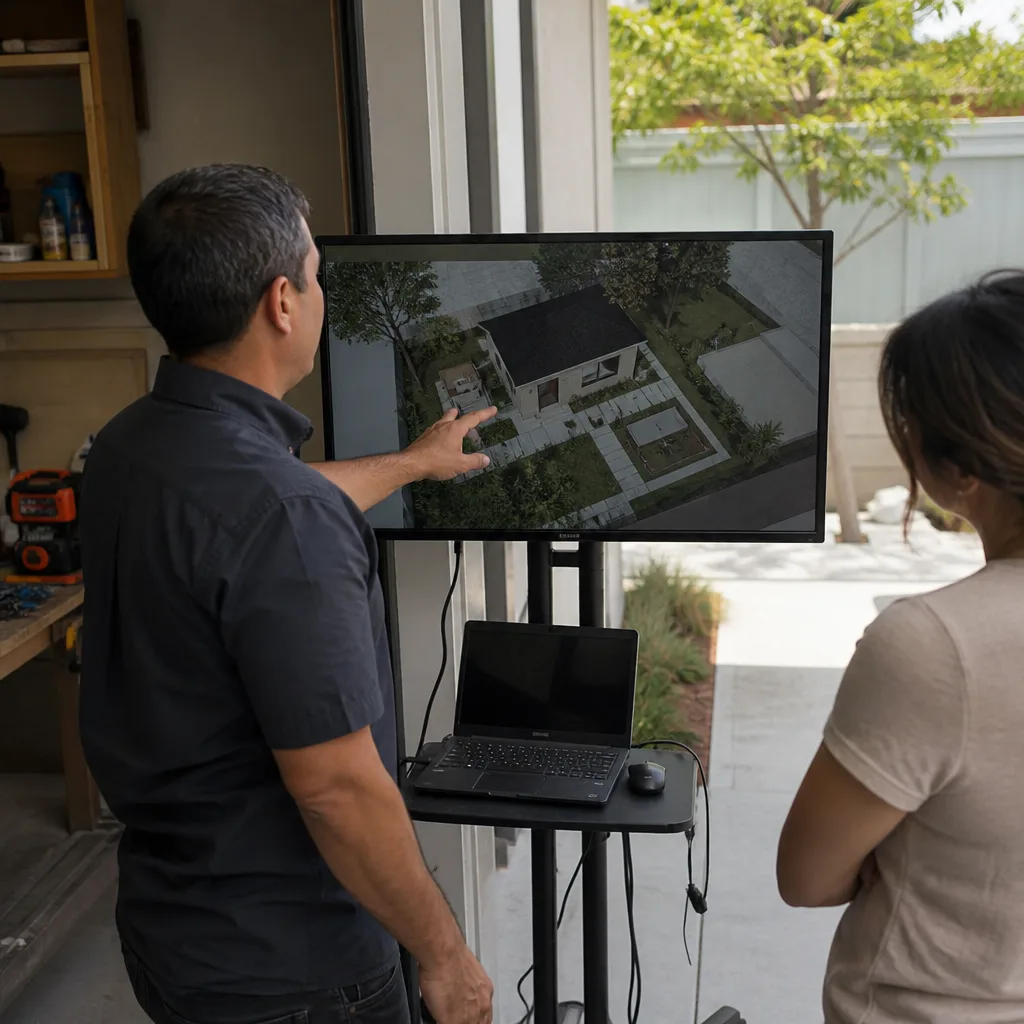
The single biggest structural decision in your ADU project isn’t floor plan or finish level. It’s whether to hire one firm for design and construction, or separate an architect from a contractor.
The split-contract model: You hire an architect or designer to produce drawings, then bid those drawings to contractors. This seems logical. It often fails because the architect’s drawings and the contractor’s budget were developed in isolation. When the contractor discovers the drawings don’t account for Irvine’s specific setback requirements or the existing sewer lateral capacity, someone must pay for redesign. The architect says the contractor is interpreting the drawings wrong. The contractor says the drawings are unbuildable. You pay for change orders while the permit clock runs.
We’ve seen this in Irvine’s Woodbridge neighborhood, where garage conversion ADUs often encounter shared driveway easements that the initial drawings missed. The architect blames the survey. The contractor blames the architect. The homeowner pays $8,000-$15,000 in redesign and re-permitting while the garage sits empty.
The design-build model: One contract, one written price, one accountable party. The same team that designs the permit set builds from it. If the drawings need adjustment for buildability, that happens internally, before permit submission, at no extra cost to you. ADU Design & Permitting in Irvine and construction are a single workflow, not a handoff.
At Ellery ADU Studio, we’ve operated this way since 2015 - the year California’s ADU laws began their major shift. Our Garage Conversion ADU in Irvine projects, New Detached ADU in Irvine builds, and every other service type flow through the same design-build process. Under Haven Standard Clause 5 (No Surprises), the scope is locked at signing; no door-side upsells, no scope creep.
The trade-off: design-build firms typically require a design agreement before construction pricing is finalized. This is proper. Anyone who gives you a firm construction price before understanding your site conditions, utility capacity, and Irvine-specific code constraints is guessing - and you’ll pay for that guess later.
Step 3: Ask These Five Permit-Set Questions
Permit quality is where cheap bids become expensive projects. These five questions separate firms that understand Irvine’s permitting environment from those who treat it as an afterthought.
Question 1: “Will you provide the complete permit set before I sign the construction contract?”
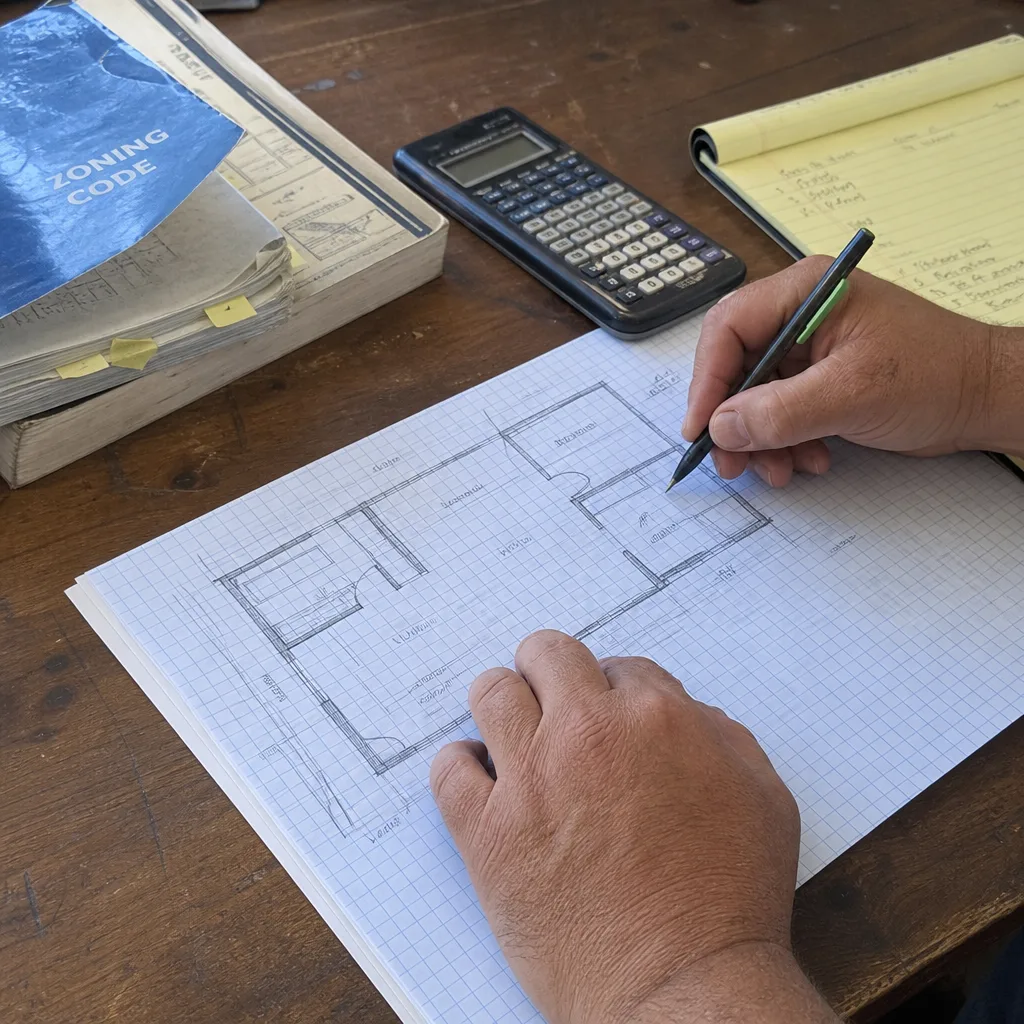
Satisfactory answer: “Yes. You’ll receive stamped architectural plans, structural calculations, Title 24 energy compliance documentation, and a site plan showing compliance with Irvine’s Zoning Code before any construction agreement is presented.”
Deflection: “We handle permits as part of the build process” or “The architect will submit after you sign.” This means you’re committing to construction pricing before knowing if the design is approvable.
Question 2: “How many rounds of plan check has your typical Irvine ADU required in the past two years?”
Satisfactory answer: A specific number - “Our Irvine ADUs average 1.2 rounds of plan check” - with explanation of what triggers a second round (often utility coordination or fire department comments on detached units).
Deflection: “The city is unpredictable” or “We can’t control plan check.” While true that cities vary, experienced firms track their metrics. Vague answers suggest they don’t.
Question 3: “Who on your team has direct experience with Irvine’s specific ADU requirements?”
Satisfactory answer: Named staff members with specific project counts in Irvine, plus knowledge of local requirements like the Irvine Unified School District’s potential impact fees for larger ADUs, or the city’s particular fire separation requirements for garage conversions.
Deflection: “We work all over Orange County” or “Permits are permits.” Irvine’s ADU ordinance has nuances - including specific parking replacement rules and landscape requirements - that differ from Santa Ana, Costa Mesa, or Tustin.
Question 4: “What happens if the permit is rejected for code issues in your drawings?”
Satisfactory answer: “We revise and resubmit at our cost. The written price doesn’t change because the permit set is our deliverable.” This is design-build accountability.
Deflection: “That’s a permit fee issue” or “The city just wants more money.” Rejections for code compliance are the designer’s responsibility. If you hired separate architect and contractor, determine who pays before you sign either contract.
Question 5: “Can I see a redlined plan check response from a recent Irvine project?”
Satisfactory answer: An actual document, with client information redacted, showing the city’s comments and the firm’s corrections. This is the permit-set equivalent of a contractor showing you a finished project.
Deflection: “We don’t share client documents” or “Every project is different.” Redacted plan check documents contain no client financial information. Refusal suggests either inexperience or poor results.
At Ellery ADU Studio, our 900+ ADU projects since 2015 include documented photo records at every visit and permit sets that clients review before construction pricing is finalized. We don’t consider a permit set complete until it includes every sheet the City of Irvine’s Building Division requires for a first-submission package.
Step 4: Read the Proposal for Scope Gaps and TBDs
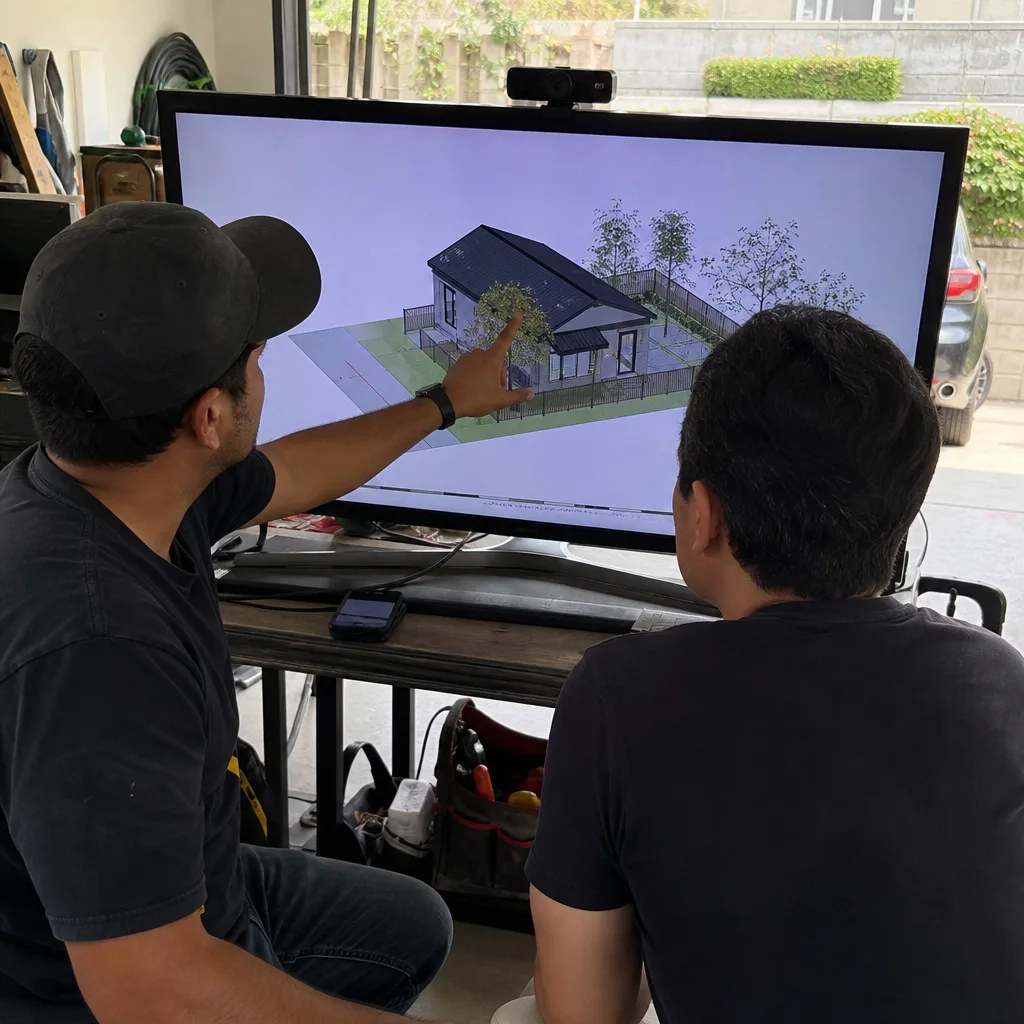
The most dangerous word in an ADU proposal is “TBD.” It appears most often in the lowest bids, and it always costs more than the difference between that bid and the next one up.
Line items that are almost always TBD in low bids, and their typical Irvine costs when they materialize:
| Line Item | Why It’s Often TBD | Typical Cost When Required |
|---|---|---|
| Utility service upgrade (electrical) | Existing panel capacity unknown until PG&E or SCE review | $3,500-$12,000 |
| Sewer lateral replacement | Condition unknown until camera inspection | $4,000-$15,000 |
| Foundation repair/replacement | Existing slab condition unknown | $5,000-$25,000 |
| Fire sprinkler system | Triggered by ADU size or main house requirements | $8,000-$18,000 |
| Soils report / geotechnical | Required for detached ADUs on slopes or fill | $3,000-$7,000 |
| Tree protection / replacement | Irvine’s tree preservation ordinance | $2,000-$10,000+ per tree |
| Off-site improvements | Sidewalk, curb, or alley upgrades required by city | $5,000-$30,000 |
A proposal with more than two TBDs is not a proposal; it’s an estimate of estimates. Under Haven Standard Clause 1, every Ellery ADU Studio project receives a written price before any work begins. We investigate site conditions - electrical service size, sewer lateral access, slab condition, tree inventory - during design, not during construction. The price you sign reflects what we found, not what we hope.
How to spot other scope gaps:
- No permit fees listed: Irvine’s ADU permit fees run $4,000-$12,000 depending on valuation. Their absence suggests either inexperience or intentional lowballing.
- No Title 24 energy compliance line item: Required for all California ADUs. Costs $800-$2,500 depending on complexity.
- “Owner to provide” for any permanent fixture: Windows, doors, appliances, or finishes listed as owner-provided shift cost risk to you without reducing project complexity.
- No contingency: Even well-scoped projects encounter unknowns. A 5-10% contingency line item indicates professional planning, not padding.
- Vague finish specifications: “Mid-grade cabinets” or “standard tile” means nothing. Specifications should name brands or performance standards - e.g., “Shaker-style cabinets, plywood box, soft-close hinges, comparable to KraftMaid or approved equal.”
In Irvine’s Northwood or Turtle Rock neighborhoods, where many homes date to the 1970s-1980s, we’ve found original electrical panels at capacity and clay sewer laterals requiring replacement. Our Seasonal ADU Care for Irvine: Year-Round Homeowner’s Guide covers how to plan for these aging-system issues before they become emergencies. These aren’t surprises if you look before you price; they’re expensive change orders if you don’t.
Step 5: Run an ADU-Specific Reference Check
Generic reference questions produce generic answers. “Were you happy?” tells you almost nothing useful about how this contractor handles the specific challenges of an ADU project.
Questions to ask previous clients:
- “How many rounds of plan check did your permit require, and how long did permitting take total?” You’re verifying permit competence, not just construction quality. In Irvine, a well-prepared permit set should clear in 6-10 weeks. Multiple rounds stretching past 16 weeks suggest drawing deficiencies.
- “Did the final price match the written proposal, and if not, what changed?” Small overruns happen. A pattern of 15%+ increases indicates systemic scope-gap problems. Ask for specific change order amounts and reasons.
- “How did the firm handle the handoff between design and construction?” In split-contract projects, this is where most failures occur. In design-build, you’re confirming the process was seamless. Listen for “we had to get the architect involved again” - that’s a red flag for any model.
- “What did the city inspector flag during construction, and how was it resolved?” Even good projects get inspector comments. The question is whether the contractor anticipated them. In Irvine, common issues include fire-rated assembly verification in garage conversions and egress window sizing in basement ADUs.
- “Would you hire them for your next ADU?” Not “would you recommend them” - that’s socially loaded. “Would you hire them again” separates genuine satisfaction from politeness.
- “Can I see your final permit set and as-built documentation?” This is the reference-check equivalent of the permit-set question above. Clients with good experiences usually keep these documents. Their willingness to share indicates project transparency.
Ask for references from projects completed 12-24 months ago, not last month’s finish. ADU projects take time, and recent completions haven’t faced the test of seasonal settlement, warranty claims, or the city’s final inspection follow-up.
At Ellery ADU Studio, we provide references with project addresses (with client permission), permit numbers, and the specific project type - garage conversion, detached new build, or JADU - so prospects can verify our work through public records, not just our word.
Step 6: Navigate Irvine’s Permitting and Code Requirements
Irvine’s ADU environment combines California’s statewide liberalization with local implementation details that matter for your project timeline and budget.
Irvine-specific factors to understand:
- ADU size limits: State law allows up to 1,200 sq ft for detached ADUs, but Irvine’s implementation includes height and setback requirements that effectively limit some lot configurations. A 1,200 sq ft ADU on a 5,000 sq ft lot in Westpark may not comply with side-yard setbacks even if it’s under the size cap.
- Parking requirements: State law prohibits parking requirements for ADUs in many cases, but Irvine requires replacement parking when a garage is converted. A two-car garage conversion must provide two replacement parking spaces on the property - often via a new driveway or carport that wasn’t in the original budget.
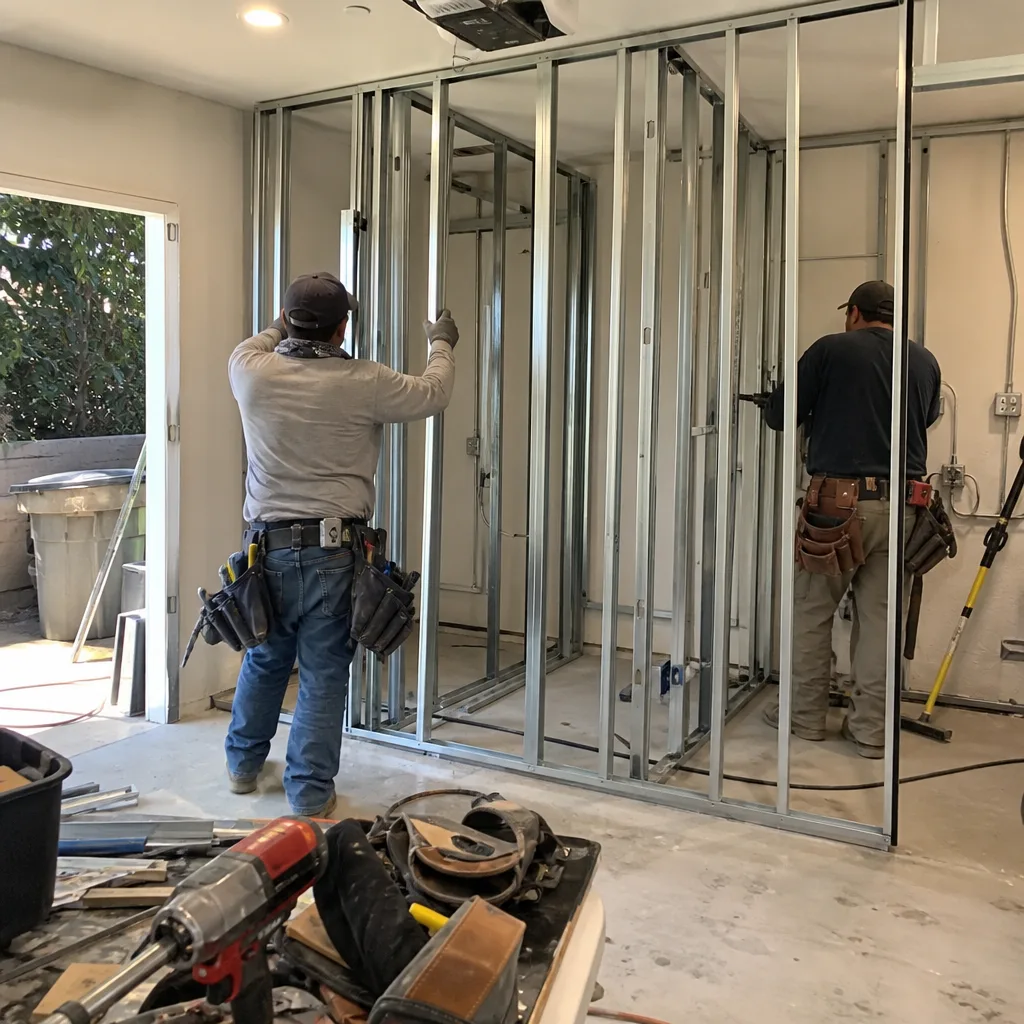
- Fire separation: Garage conversions in Irvine require specific fire-rated assemblies between the ADU and any remaining garage space. This isn’t just drywall; it’s a tested assembly with specific taping, sealing, and penetration protocols. Contractors unfamiliar with this requirement often underbid the fire-separation line item by 40-60%.
- School fees: ADUs over 750 sq ft in Irvine may trigger Irvine Unified School District impact fees. These are separate from city permit fees and can add $3,000-$5,000. Your contractor should know the threshold and include it in project budgeting.
- HOA considerations: Many Irvine neighborhoods - including most villages in Irvine Company master-planned communities - have HOAs with architectural review requirements. State law limits HOA prohibition of ADUs, but design review and aesthetic standards still apply. A contractor who doesn’t ask about HOA requirements hasn’t done enough Irvine projects.
- Climate and energy: Irvine’s mild coastal-to-inland climate means HVAC loads are moderate, but Title 24 still requires specific insulation, window performance, and ventilation standards. The city’s location in Climate Zone 8 affects energy compliance calculations. Experienced firms specify accordingly; inexperienced firms rely on generic specifications that may fail compliance review.
We’ve worked with prefab and modular systems including Dvele and Mighty Buildings in Irvine contexts, where factory-built efficiency meets local site conditions. These systems require the same permit scrutiny as site-built ADUs, plus coordination with the manufacturer’s engineering for Irvine’s specific wind and seismic requirements. Ellery ADU Studio specifies and coordinates these systems within our single-contract model, so the factory warranty and local build warranty don’t create coverage gaps.
Step 7: Understand True All-In Pricing
ADU pricing in Irvine varies by type, but the structure of the quote matters as much as the number. Our ADU Cost Breakdown: The Irvine Homeowner’s Reference for 2026 explains line-by-line what to expect. Here’s what all-in pricing actually includes.
Typical Irvine ADU cost ranges, drawings through final inspection:
| ADU Type | Typical All-In Range | What Drives the Variation |
|---|---|---|
| Garage Conversion ADU | $180,000-$280,000 | Existing slab condition, electrical service capacity, fire separation complexity, replacement parking requirements |
| Junior ADU (interior conversion) | $80,000-$150,000 | Existing bathroom access, kitchenette requirements, separate entrance feasibility, owner-occupancy verification |
| New Detached ADU (1 bed/1 bath, ~600 sq ft) | $220,000-$320,000 | Foundation type, utility trenching distance, roofing material, finish level |
| New Detached ADU (2 bed/1 bath, ~850 sq ft) | $300,000-$450,000 | All of the above, plus potential school impact fees, larger HVAC, and more complex Title 24 compliance |
These ranges assume a complete permit set, city fees, utility connections, and standard finishes. They do not assume luxury specifications or unusual site conditions.
What “all-in” must include to be comparable:
- Architectural design and structural engineering
- Title 24 energy compliance documentation
- All permit and plan check fees
- Utility connection fees (electrical, water, sewer, gas if applicable)
- Site preparation and demolition if needed
- Foundation and structural work
- Framing, roofing, exterior finishes
- Plumbing, electrical, HVAC
- Insulation, drywall, interior finishes
- Kitchen and bathroom fixtures, cabinets, countertops
- Flooring, paint, doors, hardware
- Final cleaning and project documentation
Any proposal missing more than one of these categories isn’t comparable to one that includes them. A $160,000 garage conversion bid that excludes electrical service upgrade, permit fees, and kitchen appliances is actually a $210,000 project wearing a misleading number.
Under Haven Standard Clause 1, Ellery ADU Studio provides a written price before any work begins on every project. Not an estimate. Not a range. A number, with every line item above specified, that does not change unless you change the scope. We’ve maintained this practice across 900+ ADUs since 2015.
We also offer a Free Second Opinion on any written estimate already in hand. Bring us a competitor’s proposal and we’ll identify the TBDs, the missing line items, and the permit risks - no obligation, no pressure to switch.
Common Mistakes to Avoid
- Treating the lowest bid as the baseline. The lowest bid is usually the least complete. In Irvine’s market, a bid 20% below comparable proposals almost certainly excludes permit fees, utility work, or contingency. Calculate the probable true cost before comparing.
- Skipping the CSLB lookup. License verification takes three minutes. We’ve seen homeowners skip this step because the contractor seemed professional or came recommended. An active B-General classification with no recent disciplinary actions is non-negotiable.
- Not requesting the permit set before construction commitment. This is the central error this guide exists to prevent. A contractor who won’t show you complete drawings before you sign a construction contract is asking you to buy a product whose specifications you haven’t seen.
- Ignoring Irvine’s replacement parking requirement. Garage conversions are popular in Irvine’s older neighborhoods - Woodbridge, University Park, Rancho San Joaquin - where original two-car garages are common. The replacement parking spaces must fit on your property, legally and physically. Verify before designing.
- Assuming HOA approval is automatic. State law limits HOA prohibition, but design review takes time and may impose requirements that affect cost. A contractor who doesn’t ask about your HOA hasn’t done this before in Irvine.
- Accepting verbal promises about price protection. “We won’t go over” means nothing without a written mechanism. The Haven Standard’s Clause 5 (No Surprises) is one such mechanism; there are others. What matters is that it’s in the contract, not in conversation.
- Checking references who only had construction work, not ADU work. A great kitchen remodeler isn’t automatically a great ADU contractor. The permit process, utility coordination, and code requirements differ significantly. Ask specifically for ADU references with permit completion in the past two years.
When to Call a Professional
Call a design-build ADU professional when you’re serious about understanding your property’s actual capacity - not when you’ve decided to build, but when you’re evaluating whether to build. The right time is after you’ve reviewed your lot size, setback requirements, and existing utility locations, but before you’ve committed to a floor plan or budget.
Specific scenarios that warrant professional input: your garage conversion requires fire separation from remaining storage space; your lot has slope or drainage constraints that may trigger geotechnical requirements; your electrical panel is original to a 1970s-1980s Irvine home and likely at capacity; your HOA has architectural review with deadlines that affect permitting timeline; or you’ve received a proposal with multiple TBDs and need a second opinion on what’s actually missing.
Ellery ADU Studio Irvine offers free estimates in Irvine. We’ll review your property’s specific conditions, identify the permit requirements that apply, and provide a written price before any work begins. Call (657) 233-9738 to schedule. A live person answers calls 24/7 - no voicemail queue, no callback promise that doesn’t materialize.
Frequently Asked Questions
Garage conversion ADUs in Irvine typically run $180,000-$280,000 all-in, while new detached ADUs range from $220,000-$450,000 depending on size and site conditions. Junior ADUs, which use existing interior space, generally cost $80,000-$150,000. These ranges include design, permitting, construction, and standard finishes - but always verify what’s included in any specific proposal, as “TBD” line items can add 15-30%. Call (657) 233-9738 for a written price on your specific property; estimates are free.
A complete, first-submission permit set in Irvine typically clears plan check in 6-10 weeks. Incomplete submissions or those requiring multiple rounds of correction can extend to 16-24 weeks. The difference is almost always permit set quality, not city backlog. Contractors with strong Irvine track records know the Building Division’s specific requirements and prepare accordingly. At Ellery ADU Studio, our Irvine ADUs average 1.2 rounds of plan check because we submit complete packages.
You don’t need separate professionals, and in most cases, you shouldn’t. The design-build model - one contract for drawings and construction - eliminates the blame gap that derails many ADU projects. When architect and contractor are separate entities, disputes over buildability, code interpretation, and change order responsibility fall to you. A unified design-build contract places accountability with one firm. Ellery ADU Studio has operated this way since 2015.
The primary contractor must hold a B-General Building license from the CSLB. Trade work - plumbing, electrical, HVAC, roofing - requires C-classifications, which the prime contractor may hold or must subcontract to licensed specialists. Verify every license at cslb.ca.gov before signing. In Irvine, we regularly encounter unlicensed “project managers” who subcontract everything; this creates liability gaps CSLB cannot resolve.
California law prohibits HOAs from outright banning ADUs, but HOAs in Irvine’s master-planned communities - including most Irvine Company villages - retain design review authority. This means your ADU must meet aesthetic and architectural standards, which may affect materials, colors, roof style, or placement. Your contractor should ask about HOA requirements during initial consultation, not after design is complete. Failure to account for HOA review can add 4-8 weeks to your timeline.
The 365-Day Done Right Promise, part of The Haven Standard at Ellery ADU Studio, guarantees that if your finished ADU is not built to the permitted drawings, we make it right - in writing, before your project starts. This is not a generic satisfaction guarantee; it’s a specific warranty tied to permit compliance and construction quality, backed by documented photo records from every project visit. Most contractors offer no comparable protection; those that do typically limit it to 30-90 days.
The Bottom Line
Hiring an ADU contractor in Irvine is not a bidding exercise. It’s a due diligence process centered on permit competence, contract structure, and accountability mechanisms. Verify licenses on the CSLB lookup. Demand a complete permit set before construction commitment. Read every proposal for TBDs and scope gaps that convert low bids into high final costs. Choose between design-build and split contracts based on who bears the risk when drawings and buildability conflict. Run reference checks that verify permit track record, not just construction quality. And understand Irvine’s specific requirements - replacement parking, fire separation, school fees, HOA review - that affect timeline and budget.
The contractor who bids $180,000 with a vague scope and no permit set is not cheaper than the one who bids $210,000 with complete drawings and a written warranty. The first bid carries an unknown permit correction cost that the second has already absorbed. In Irvine’s strict permitting environment, permit quality is price quality.
Written by Nadia Ellery, Owner at Ellery ADU Studio Irvine, serving Irvine since 2015.